Showing posts with label COMPUTER. Show all posts

AMD Releases Its New Graphics Card

AMD Releases Its New Graphics Card


AMD introduced its new ATI Radeon HD 4830 graphics card, raising the bar for products under $100{approx Rs 4900}.
The new card features 640 stream processors (128 five-way superscalar shader units), 32 texture units, 16 ROPs and a 256-bit memory interface. The 512 MB of GDDR3 memory run at 1,800 MHz, which will provide an excellent performance for its price.


The HD 4830 supports AMD's ATI CrossFireX technology designed to allow gamers to combine a maximum of four cards on a single PC in order to significantly boost a game’s performance. Another plus is that the card supports 7.1 HD multichannel audio, also known as surround sound and also supports picture-in-picture technologies.
"The ATI Radeon HD 4830 graphics card is another example of how AMD's scalable design strategy is paying off. With a single chip, we have been able to quickly and efficiently bring to market graphics card designs ranging from below $150 through $549 SEP, with leading performance in every segment. The ATI Radeon HD 4830 continues that great trend, providing tremendous value to gamers for less than $150," explained Rick Bergman, senior VP and general manager of Graphics Products Group/AMD, in a recently released statement.
The company is looking to release products that will appeal to a wide public, concerned about both performance and price. The new ATI Radeon cards are being presented as an affordable solution to today’s gamer, who demands quality at an attractive price. The ATI Radeon HD 4830 graphics card is expected to become a great success for AMD.

flash player 10 introduced

Adobe Adds 3-D Dev Tools to Flash

The 10th version of Adobe's Flash Player emphasizes features relating to 3-D animation and text effects. The new release includes new support for custom filters and effects, native 3-D transformation and animation, advanced audio processing and GPU hardware acceleration.


Adobe released the 10th version of its Flash Player Wednesday. Flash Player 10 includes new features and enhancements that give Web developers greater creative control when designing their interactive content and video.
Flash Player 10, according to Barclay, brings together both of those worlds, adding a lot of new expressive features, with 3-D and text support normally found only in print publications. Adobe has also added the ability for designers to create their own custom filters and effects.

"We're combining that with more performance improvement, but more focused on visual performance to give you a better whole application experience," he added.

MICROSOFT INTROUCES ITS NEW LANGUAGE

MICROSOFT INTRODUCES ITS "M" LANGUAGE

In a software-centric world where we already have many, many languages to program in, from scripting to bytecode compiled languages, to frameworks on top of languages and embedded languages, now Redmond wants to bring ANOTHER language to the table, titled ‘M’ (for Microsoft?).

The new language is to be a part of Microsoft’s new Oslo development and service-oriented strategy, incorporating features from XAML while being textual and domain-specific. M is to be used directly with 2 other components to be released with M along with Visual Studio 2010: Quadrant, a tool for building models visually, and a repository for storing and viewing models in an SQL database.

Microsoft has not said much other than that about the new language, but it will presumably be a compiled .net language (goodbye true native code), and from what Microsoft said, M is to strive to be cross-platform…. with a catch.

By “cross platform”, Microsoft means, “cross platform as long the other platform authors write a backend for the code, and the SQL database MUST be hosted on MS SQL, a proprietary Microsoft Windows service”. It makes perfect sense for being cross platform, if you are Microsoft and trying to purchase many copies of Windows (therefore generating revenue, and presumably the version is Vista or win2k8 since XP is out).

Another source says the language is actually their ‘D’ language (and no, Microsoft did not originally invent D either), only revamped to fit into their new Oslo modeling strategy and renamed to a further letter down the alphabet to attract new interest in an old product. While this may be mostly true, D, which was never really promoted as a .net compilable language (it just kinda disappeared) had many flaws and never really caught on although some were enthusiastic about it (just like Bill Gates said we would write code for OS/2 for the next 10 years after its release).

The fundamentals and principals of the language are attractive, especially for OOP, but its ties to MS SQL and .net would only really make it attractive to Windows-specific applications, although its integration with ASP.net is unclear at this point. The mono project does a descent job of allowing .net code to run on non-windows platforms, and if M adheres to the same standards then after a given time M-written applications will be penguin-friendly as well if Microsoft can get around the MS SQL dependency.

Time will only tell how many will actually use the language outright before Microsoft finds a way to force programmers to use it, most likely by dropping support for some features in all languages except M to promote its usage. For now it appears that the only “non-visual” C/C++ code encouraged for usage with Windows by Microsoft is in fact Windows itself, given the fact that Microsoft’s programmers are on Microsoft’s payroll. But if all newbie programmers learn these new languages, who will manage the billions of lines of C and C++ we currently use in the future, unless it is implied to be completely be rewritten? I’m sure the folks from the original Bell labs team would be interested in the answer to these questions as well.

INTEL USB 3.0 {contd.}

| 0 comments

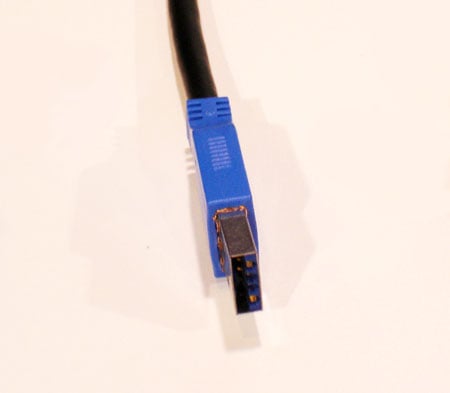
CONNECTORS OF USB 3.0


The USB 3 CONNECTOR...

The standard USB 3 connector

...and in close-up...


The standard USB 3 connector

...and in diagrammatic detail


Here's the socket:


The standard USB 3 receptacle

The standard USB 3 socket...


The standard USB 3 receptacle

...which you can see more clearly in this diagram


And, finally, the mini-socket:


The USB 3 mini-receptacle


ACCORDING TO THE SOURCES.................


USB set to go to 3 for HD


IDF The brains behind USB are to take the peripheral interconnect technology into the HD era with a new version, 3.0, due to be completed by the middle of 2008.

USB 3.0 is set to deliver a data transfer rate of up to 4.8Gbps - ten times today's 480Mbps USB 2.0 data rate - and introduce optical interconnects to the bus. The goal, the companies behind the specification said, is to create a version of the bus that's able to deliver files of 25GB or more.


USB 3 optical connector

Let there be light: a USB 3 optical connector

Coincidentally, that's the capacity of a single-layer Blu-ray Disc and just under the capacity of a dual-layer HD DVD. Leading USB 3.0 development are Intel, Microsoft and HP - all HD DVD supporters.

Taking USB into the HD era goes beyond the ability to deal with the kind of files that will require such next-gen optical media for storage, but also involves looking beyond copper cabling. Details were scarce, but the USB 3.0 Promoter Group - which includes the three aforementioned firms, along with NXP, NEC, Texas Instruments and others - is looking to lay the ground work for optical connections.

These may not form part of the USB 3.0 specification, but the standard will have the necessary hooks to allow subsequent versions of it to operate over optical links.

However, the group said the new release would not ignore USB 1.1 and USB 2.0, with both older versions of the bus set to be supported by the next one. How it will operate alongside Wireless USB remains to be seen. WUSB products are only just starting to appear, and while some people may be tempted by its cable-free operation, they may want to wait for a faster-but-cabled standard potentially appearing in products late 2008.


INTEL USB 3.0

On September 18, 2007, Pat Gelsinger demonstrated USB 3.0 at the Intel Developer Forum. USB 3.0 is targeted at ten times the current bitrate, reaching roughly 4.8 Gbit (600 MB/s) by utilizing two additional high-speed differential pairs for "Superspeed" mode, and with the possibility for optical interconnect. The two new differential pairs make the cable about as thick as an ethernet cable and provide full-duplex transfers.The USB 3.0 specification was 90% complete as of August 13, 2008 and commercial products are expected to arrive in 2009 or 2010. USB 3.0 is designed to be backwards-compatible with USB 2.0 and USB 1.1 and employs more efficient protocols to conserve power while increasing the maximum power available for connected devices.

FIREFOX 3: BETA 4

| 0 comments

FIREFOX RELEASED ITS 4th PUBLIC BETA FOR ITS NEW VERSION FIREFOX 3.
IT HAS 900 MORE & NEW ADD-ONS THEN ITS PREVIOUS BETA.
IT IS RELEASED IN 43 DIFFERENT LANGUAGES.
SO IF U WANNA DOWNLOAD:

INTERNET EXPLORER 8

| 0 comments

MICROSOFT HAS RELEASED THEIR INTERNET EXPLORER 8(beta 2).
IT IS FREE OF COST TO DWNLOAD.
SO WHY NOT TO DOWNLOAD.
TAKE IT HERE IS THE LINK

FOR WINDOWS VISTA & WINDOWS SERVER 2008

&

FOR WINDOWS xp SP2

DOWNLOAD & ENJOY

)