The Palm Eos has a 2.63-inch capacitive touchscreen display with a resolution of 320 x 400 pixels, 4GB of storage, and a GPS receiver. The final touches on the specs sheet include a 2 megapixel fixed focus camera with a flash, stereo Bluetooth (A2DP) and a microUSB port.

The Palm Eos should be announced for AT&T in the US at a price of 350 US dollars before any rebates. And since perhaps we didn't make ourselves clear up until now, the Eos is still a rumored device - though all the information seems rock solid.
Source


Apple (AAPL) blew out expectations for March quarter sales and earnings. The iPhone was especially strong. But Apple's iPod touch -- its most expensive iPod -- is also crushing it, and that's a big reason that Apple will top 1 billion iPhone/iPod touch app downloads in the next day or two.
Apple sold about 3 million iPod touches last quarter. Compared to 3.8 million iPhones shipped, that is pretty excellent.
How'd we get that number? During today's earnings call, Apple revealed that it's sold 37 million iPhones and iPod touches to date. But separately, it said it has sold more than 21 million iPhones to date. Last month, Apple said it had sold about 13 million iPod touches through the end of last December. So that's about 3 million from January through March.
This -- combined with the success that PC makers like Acer are having selling cheap "netbook" PCs -- tells us one thing: That Apple could probably be successful selling a larger "iPod touch HD" later this year that fits somewhere between the iPod and the MacBook.

Blueetooth SIG has announced today that it has formally adopted the Bluetooth Core Specification Version 3.0 High Speed (HS), also known as Bluetooth 3.0. The new release of the short-range wireless technology is meant to offer increased data transfer speeds and wireless Bluetooth experience at the same time. Manufacturers of devices that utilize the technology can now apply it in their products, offering users the possibility to send large amounts of video, music and photos between different electronics and home entertainment devices.


Nokia announced 7 New Low Cost phones which will be available in 2009
The new phones include 7100 Supernova, 5130 XpressMusic, 2320 classic, 2323 classic, 2330 classic,1202(nokia’s cheapest phone ever),1661
Nokia might have missed the Diwali season this year in India and might try to cover up for this in the New Year !
These handsets have the most basic features according to the price.
7100 Supernova

This is the low cost addition to the SuperNova Range of phones . Its affordable yet stylish and has the basic set of features. It sports a large screen and supports audio and video playback.


Which Nokia do u want to buy in the New Year ? which one do you like ?
Microsoft has launched Live Search Maps for India that offers access to detailed street maps for nine cities, business listings across 29 cities and access to highway networks to 20,000 cities and towns.
The service is the first version of its local mapping service for India with the key features developed by the Microsoft India Development Centre (MSIDC) based in Hyderabad. Available both on PC and mobile, Live Search Maps for India is available on Microsoft's Live Search Service.
The key features of the service includes street maps, location search, business listing search, routing or directions for navigation and options for users to print, share collections through email, blogs on Windows Live.
AMD introduced its new ATI Radeon HD 4830 graphics card, raising the bar for products under $100{approx Rs 4900}.
The HD 4830 supports AMD's ATI CrossFireX technology designed to allow gamers to combine a maximum of four cards on a single PC in order to significantly boost a game’s performance. Another plus is that the card supports 7.1 HD multichannel audio, also known as surround sound and also supports picture-in-picture technologies.
The 10th version of Adobe's Flash Player emphasizes features relating to 3-D animation and text effects. The new release includes new support for custom filters and effects, native 3-D transformation and animation, advanced audio processing and GPU hardware acceleration.
Adobe released the 10th version of its Flash Player Wednesday. Flash Player 10 includes new features and enhancements that give Web developers greater creative control when designing their interactive content and video.
Flash Player 10, according to Barclay, brings together both of those worlds, adding a lot of new expressive features, with 3-D and text support normally found only in print publications. Adobe has also added the ability for designers to create their own custom filters and effects.
"We're combining that with more performance improvement, but more focused on visual performance to give you a better whole application experience," he added.

In a software-centric world where we already have many, many languages to program in, from scripting to bytecode compiled languages, to frameworks on top of languages and embedded languages, now Redmond wants to bring ANOTHER language to the table, titled ‘M’ (for Microsoft?).
The new language is to be a part of Microsoft’s new Oslo development and service-oriented strategy, incorporating features from XAML while being textual and domain-specific. M is to be used directly with 2 other components to be released with M along with Visual Studio 2010: Quadrant, a tool for building models visually, and a repository for storing and viewing models in an SQL database.
Microsoft has not said much other than that about the new language, but it will presumably be a compiled .net language (goodbye true native code), and from what Microsoft said, M is to strive to be cross-platform…. with a catch.
By “cross platform”, Microsoft means, “cross platform as long the other platform authors write a backend for the code, and the SQL database MUST be hosted on MS SQL, a proprietary Microsoft Windows service”. It makes perfect sense for being cross platform, if you are Microsoft and trying to purchase many copies of Windows (therefore generating revenue, and presumably the version is Vista or win2k8 since XP is out).
Another source says the language is actually their ‘D’ language (and no, Microsoft did not originally invent D either), only revamped to fit into their new Oslo modeling strategy and renamed to a further letter down the alphabet to attract new interest in an old product. While this may be mostly true, D, which was never really promoted as a .net compilable language (it just kinda disappeared) had many flaws and never really caught on although some were enthusiastic about it (just like Bill Gates said we would write code for OS/2 for the next 10 years after its release).
The fundamentals and principals of the language are attractive, especially for OOP, but its ties to MS SQL and .net would only really make it attractive to Windows-specific applications, although its integration with ASP.net is unclear at this point. The mono project does a descent job of allowing .net code to run on non-windows platforms, and if M adheres to the same standards then after a given time M-written applications will be penguin-friendly as well if Microsoft can get around the MS SQL dependency.
Time will only tell how many will actually use the language outright before Microsoft finds a way to force programmers to use it, most likely by dropping support for some features in all languages except M to promote its usage. For now it appears that the only “non-visual” C/C++ code encouraged for usage with Windows by Microsoft is in fact Windows itself, given the fact that Microsoft’s programmers are on Microsoft’s payroll. But if all newbie programmers learn these new languages, who will manage the billions of lines of C and C++ we currently use in the future, unless it is implied to be completely be rewritten? I’m sure the folks from the original Bell labs team would be interested in the answer to these questions as well.

The fingernail-sized 16GB memory cards allow consumers to utilize the many storage-intensive features offered by today’s portable handsets such as music and video playback, high-definition digital camera functions, gaming and GPS applications. In addition to mobile phones, consumers can use the 16GB microSDHC card in a multitude of other devices, including video cameras, GPS receivers or MP3 players with a microSD slots such as SanDisk’s Sansa players.
Note that these storage cards cannot be used on legacy mobile phones that supported a maximum capacity of 2GB memory cards. However, most newer cellphone models support large capacity storage cards.
SanDisk’s 16GB microSDHC card has an MSRP of $99.99 and the 16GB M2 card has an MSRP of $129.99 and come with a five-year limited warranty.
Formerly known as Nokia Tube, the first S60 handset to feature touchscreen technology will run on the new edition of the OS - Symbian S60 Taco 5.0. Despite packing a generous 3.2-inch screen with the exciting widescreen resolution of 640 x 360 pixels Nokia 5800 XpressMusic will be more of an upper midrange than a high-end device. It will come complete with a 3.2 megapixel autofocus shooter, and will be able to capture videos at up to VGA resolution at 30 fps.

5mm and will come with quad-band GSM support and 3G with HSDPA. The weight is also quite acceptable, standing at 109 grams. Some of the other extras include: GPS, 3.5mm standard audio jack, TV-out and a microSD card slot. According to the reviewer the handset will also have an 8GB card included in the retail package, just like Nokia N85.
With only 8 days to go until the Nokia 5800 XpressMusic official annoncement you can bet we are just excited as you are to take a look at it. However we can't help ourselves but wonder why Nokia didn't come up with a high-end device as a pioneer for its new OS as it would have demonstrated its capabilities that much better.

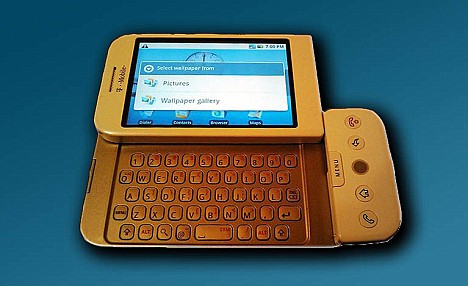
Later on today T-Mobile and Google will announce the first smartphone based on the Android platform. However images and some of the specs of the device already leaked. Have a look-see of those, while we wait for the real deal.
The T-Mobile G1 is definitely not among the most nice looking handset out there - the design could have benefited from some additional time on the drawing board. Nevertheless, the first Android handset sports a cool looking specs sheet and it's the OS that attracts the attention. Gizmodo seem to have a nice list of the 10 most interesting upcoming Android apps - be sure to check those.
As TmoNews reports, the T-Mobile G1 will have a 65K color HVGA screen (480 x 320 pixels), which the same resolution as the iPhone. Touchscreen it is, too - but the G1 will also have a trackball below the display. The G1 will measure the same height as the iPhone, only a bit less wide and slightly thicker.
The T-Mobile G1 will also have a 3 megapixel camera, but unfortunately there's no video recording. The iPhone is clear evidence that manufacturers can get away with that. Bluetooth functionality will be initially rather limited - only headset connectivity - but full support will come later on. Sound all too familiar again.
Other than that, you can expect all the other usual high-end stuff such as GPS, Wi-Fi, and 3G. We doubt T-Mobile customers will benefit much from the 3G functionality, given the dodgy coverage but we are sure things will get better with time.

T-Mobile G1 is not much of a looker

That's it for now, stay tuned for more information. The official presentation is due to start in 10:30 AM EST or 16:30 CET.
The next version of Bluetooth after v2.1, code-named Seattle (the version number of which is TBD) has many of the same features, but is most notable for plans to adoptultra-wideband(UWB) radio technology. This will allow Bluetooth use over UWB radio, enabling very fast data transfers of up to 480 Mbit/s, while building on the very low-power idle modes of Bluetooth.
The future of Bluetooth
It is estimated that there are more than one billion devices in use that utilize Bluetooth wireless technology. You can expect that number to rise sharply when Bluetooth 3.0 hits the market.
Bluetooth 3.0
Bluetooth 3.0 is the new Bluetooth wireless standard currently in development by the Bluetooth SIG and Wi-Media Alliance. The new standard is reportedly up to 160 times as fast as Bluetooth 2.1, and builds upon the previous standards. With such a rapid jump in transfer speeds, the technology has the potential to revolutionize the consumer electronics industry.
It's FAST
Bluetooth 3.0 will reportedly transfer files at rates of 480 megabits (60 Megabytes) per second in close proximity, and 100 megabits (12.5 Megabytes) per second at 10 meters. At those speeds, high-quality streaming video is a definite possibility, along with a host of other applications that are simply impractical with the current transfer rates.Picture this...
With Bluetooth 3.0, camcorders will stream video footage or still photos to Bluetooth enabled televisions and computers; digital cameras will stream photo slideshows to cell phones, and laptops will have the ability to transfer presentations wirelessly to a projector. Use your imagination — the possibilities are really exciting.High bandwidth mitigates interference
Bluetooth 3.0 will operate in the 6-9 GHz range rather than the current 2.4 GHz range, eliminating the concern of interference from wireless networks and other devices that use the 2.4 GHz range.Backwards compatibility
Best of all, Bluetooth 3.0 will be backwards-compatible, so all of your old devices will be able to communicate with the new ones and vice versa. New devices will feature a 2.4 GHz Bluetooth radio on the same radio chip, or its own separate chip. But bear in mind that transfer speeds are only as fast as the slowest device, meaning that the two will exchange data at the slower, 3-megabit rate of Bluetooth 2.1.
Bluetooth wireless technology has made some major strides in the past few years, and the new 3.0 standard has the potential to remove not only the wires, but the communication barriers between devices that have existed for years as well.


